Agent Memory Persistence Across Sessions
Building persistent memory for agents requires separate storage tiers for different memory types.
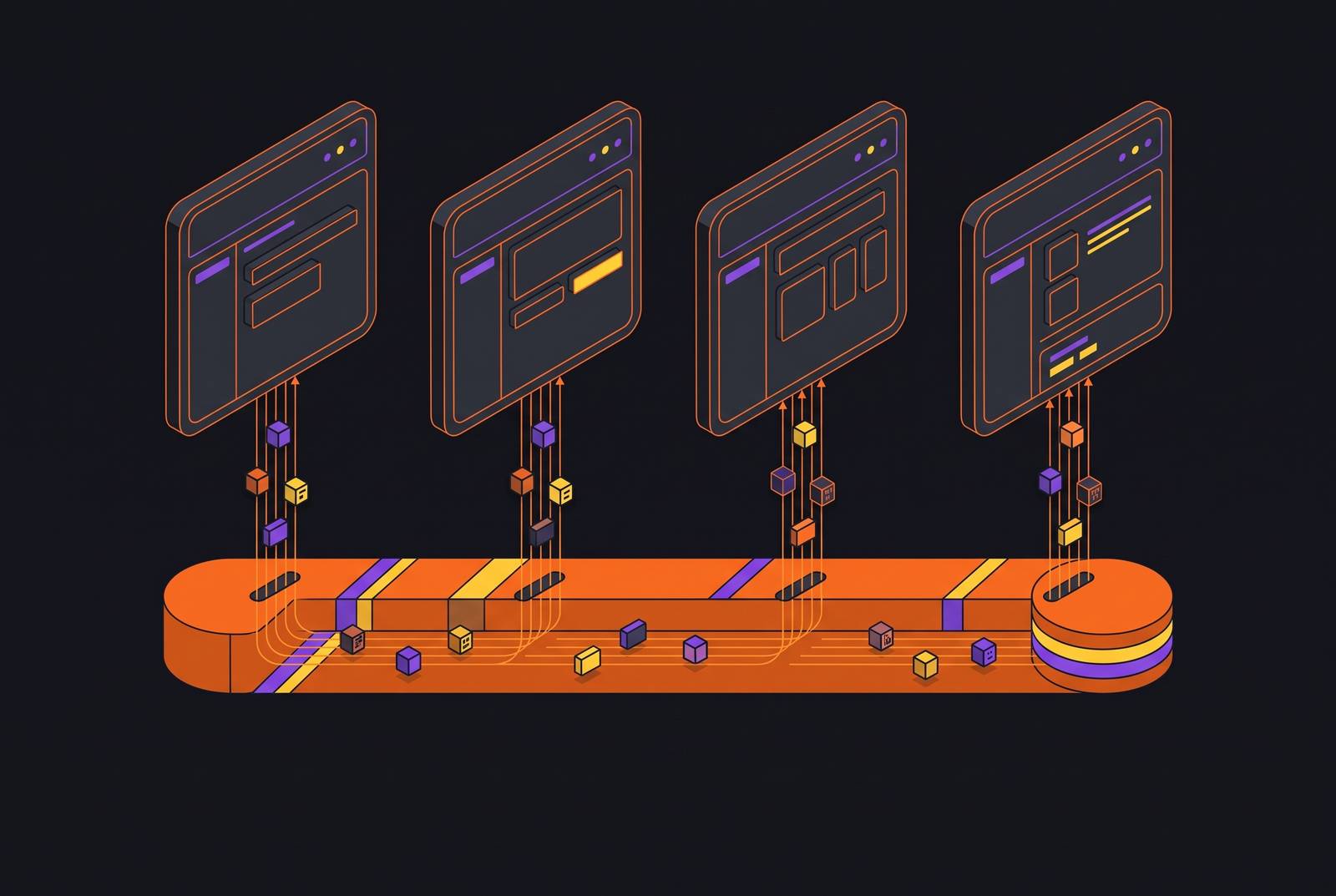
Every call to a large language model is stateless by design. It gets no information from any previous call unless the application sends it along explicitly, every single time. That single fact explains almost every complaint developers have about agents that seem to "forget" who they're talking to.
The context window gets mistaken for memory constantly, but it's better understood as a working buffer: fast, immediate, and entirely temporary. Making the window bigger doesn't change this. The model's trained weights don't help either: weights are a fixed snapshot built during training, and they can't absorb a new fact a user mentions at runtime no matter how the prompt is phrased.
In production, the consequence is blunt. An agent with no external memory layer cannot tell a returning user from a brand-new one. It cannot recall what task it was handling five minutes before a network hiccup. It will ask a user to repeat information that user already gave it, sometimes in the same conversation. An agent without persistent memory is nearly a third more likely to hallucinate or ignore specific user constraints than one with proper context retention. That gap is a direct function of what gets lost between one call and the next, not a quirk of any particular model or prompt style.
None of this is a flaw in the models themselves. It's a gap in the infrastructure built around them. Forgetting is the default behavior of any stateless system, and the only way past it is to build the parts of the system that hold state deliberately, rather than assuming the model will somehow carry it.
What "memory" means for an agent: four distinct problems, not one
Treating "memory" as one feature to bolt onto an agent is the first mistake most teams make. Memory breaks down into four separate concerns, and each one demands a different piece of infrastructure.
In-context, or working, memory is everything currently sitting in the model's context window: the prompt, the conversation so far, whatever a tool just returned. It's effectively free to access and has no retrieval latency at all, but it's capped by the size of the window and gone entirely once the session ends. It's useful for the task at hand and useless for anything beyond it.
Episodic memory is the record of specific, time-stamped events: what the user asked on a given day, what the agent did in response, and what came of it. If an agent needs to recall that a user asked it to convert a file to TypeScript on April 3, that's an episodic fact, tied to a moment.
Semantic memory holds generalized, distilled facts that aren't tied to a timestamp. It doesn't matter when the agent learned it; it matters that it's true going forward. That distinction, time-stamped versus general, is what separates episodic memory from semantic memory, and conflating the two leads teams to store facts in the wrong place and retrieve them the wrong way.
A persistent memory layer is the piece of infrastructure that handles the long-lived types, episodic, semantic, and procedural memory, and it sits apart from the application's own operational database. It's purpose-built to answer the kinds of questions an LLM asks of its memory: what's relevant right now, and how does it connect to what the model already knows. Each of these four types maps to a different storage backend with a different retrieval pattern, and that mapping is the actual architecture question developers need to answer.
The tiered storage architecture that makes cross-session memory work
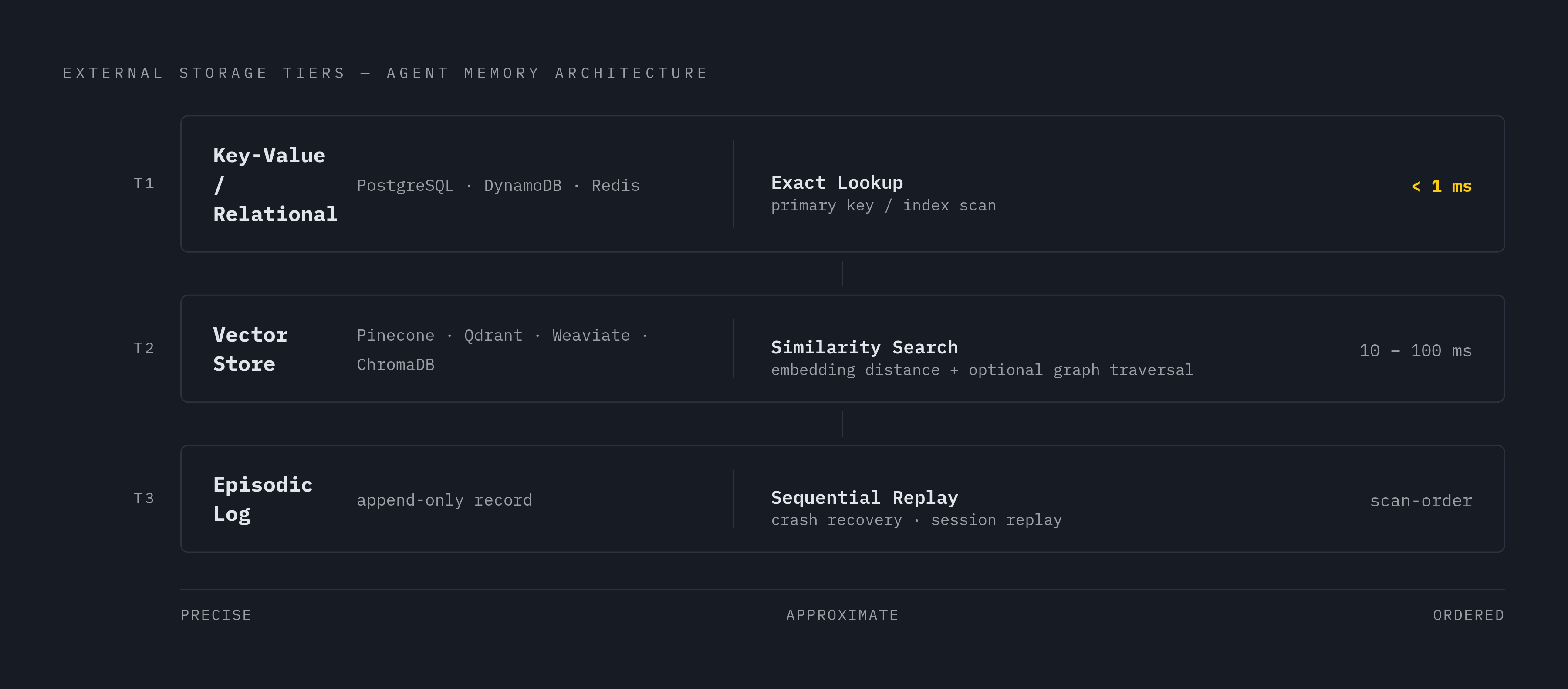
Once the four types of memory are separated out, the next step is matching each one to the right storage tier. Production agents generally need a three-tier external storage setup, and each tier is built around a specific retrieval pattern and a specific latency budget.
The first tier is a structured, key-value store: something like PostgreSQL, DynamoDB, or Redis. This tier holds exact facts: account IDs, subscription tiers, stated preferences, specific entity attributes. Reads come back in under a millisecond through a direct SQL query or key lookup, and the data survives across sessions without any ambiguity about what it means. Specific rows can be pinned to a regional cluster to satisfy data sovereignty rules, which matters directly for fintech products and anything operating under GDPR.
The second tier is a vector store: Pinecone, Qdrant, Weaviate, or ChromaDB are common examples. This tier turns past conversations and facts into embeddings, so the agent can retrieve by similarity instead of by exact keyword match. This is the tier that makes cross-session retrieval-augmented generation work at all: an agent can pull back a conversation from three weeks ago that's thematically related to the current one, even if it shares no exact words with it. Graph-vector hybrids go a step further, adding relationship traversal on top of similarity search, which supports queries that plain similarity can't answer: not just finding something that sounds related, but finding what a client said about a budget after a contract was signed, which requires reasoning across connected facts rather than just matching nearby ones.
The third tier is the episodic log: an append-only record of the agent's full message history. The agent's message log functions as its actual state, and persisting it enables crash recovery and session resumption, along with debugging after the fact, not just recall of what was said.
Picture the three tiers as a simple chain running from storage layer to persistence behavior to retrieval method. The key-value store persists indefinitely and answers exact lookups in under a millisecond. The vector store persists indefinitely and answers similarity queries through embedding search, with graph traversal layered on top where relationships matter. The episodic log persists indefinitely and answers sequentially, an ordered record an agent can replay. None of the specific products named here are a recommendation; they're just the examples teams currently reach for in each category.
Metadata filtering isn't optional alongside vector retrieval. At query time, the retrieval pipeline needs to layer these tiers deliberately: memories scoped to the specific user rank above general session context, which in turn ranks above raw history, so the facts at the top of the agent's working context are always the most specific and the most relevant ones available.
Getting the tiers right solves half the problem; the agent must also know, with certainty, whose memory it's pulling from.
The identity problem: memory is only as good as the ID scheme that addresses it
A memory system can have every tier built correctly and still fail in production, because storage only works if the agent can reliably tell which entity an interaction belongs to across sessions. This is where a lot of otherwise well-built systems start misbehaving in ways that look like memory bugs but aren't.
The API design that has emerged to handle this uses a multi-scope identifier scheme rather than a single ID. A user_id holds memories belonging to a specific person, persisted across every session that person has. An app_id holds context shared across an entire organization, and multiple agents can access it at once. These scopes compose at query time, with user-level memories ranked above session context, which in turn ranks above raw history, so the agent surfaces the most specific and relevant facts first.
Cross-session identity resolution produces mismatches that the memory layer cannot resolve on its own; that gap is what causes the failures below. No amount of tiering or retrieval tuning solves an identity mismatch that happens before a query ever reaches storage.
A related failure mode is temporal staleness. An agent that still treats a six-month-old preference as current fact will act on it with full confidence, with nothing in the architecture flagging that the fact might have expired.
These are exactly the failure modes the field has started measuring directly. LoCoMo, LongMemEval, and BEAM are now the standard benchmarks for comparing memory architectures against each other. BEAM in particular tests ten distinct memory ability types, including knowledge update, contradiction resolution, multi-session reasoning, abstention, event ordering, information extraction, instruction following, preference following, summarization, and temporal reasoning, at a scale running up to 10 million tokens. Those ten categories map closely onto the identity and staleness failures just described, which is what makes the benchmarks useful: they measure the gap between a storage layer that looks correct and a system that behaves correctly.
Identity and staleness are software-layer problems, solvable with the right ID scheme and the right re-weighting logic. But even a system that gets identity exactly right still depends on the compute environment the agent actually runs in between sessions.
Why the compute layer is where memory architecture breaks down
A carefully designed storage layer gets undermined fast if the compute environment running the agent is destroyed between sessions. Everything that wasn't explicitly flushed to external storage goes with it: open file handles, installed packages, live browser sessions, any in-flight state the agent hadn't written down yet.
Containers, as the isolation layer for this kind of workload, fall short in a specific way. Containers, denylists, and permission prompts all exist in the same userspace the agent itself reasons in. Isolation is enforced by software convention rather than by hardware. An agent with code execution capability can reason its way around a software convention. And a shared container daemon managing several agents at once means one agent's failure, or one resource spike, can affect every other agent on that daemon: the operational blast radius has no real ceiling.
Firecracker micro-VMs change that guarantee. Each agent workload runs inside its own microVM, managed by a dedicated virtual machine monitor process, with isolation enforced by hardware sitting below the layer the agent is capable of reasoning about. Firecracker itself is an open-source virtual machine monitor written in Rust, originally open-sourced by Amazon in 2018 to run serverless workloads with the isolation of a full VM at something closer to the speed of a container. In June 2026, AWS made the connection to agent workloads explicit by launching AWS Lambda MicroVMs: stateful, isolated execution environments where a session can run for an extended stretch of time, with fast startup because the runtime resumes from a Firecracker snapshot of a pre-initialized environment instead of booting from zero.
The practical implication follows directly from that: the right infrastructure primitive for a persistent agent is a VM that can sleep and wake on demand. It is not a function that terminates completely on every call, backstopped by a database trying to compensate for the compute layer's amnesia. Sleeping and waking a VM instead of destroying and rebuilding it changes what the memory architecture can assume about continuity, but it also raises a question the previous sections haven't touched: what does keeping that state alive actually cost.
The economics of keeping an agent's state alive between sessions
Most agents spend most of their time doing nothing. The tractable fix is to pause the environment and preserve its state rather than destroy it outright or, at the other extreme, leave it running continuously just in case.
The distinction that matters here is how a platform scales to zero. Others scale to zero by pausing the sandbox and preserving its state for an instant resume later. That distinction means scaling to zero is compatible with keeping agent memory intact only if the sandbox state is preserved for instant resume; otherwise it quietly reintroduces the amnesia problem the storage layer was built to solve.
A detailed cost model for a background coding agent, running on a 2 vCPU / 4 GiB sandbox across thousands of sessions a month, each doing a short burst of real work before sitting idle, shows the magnitude of the difference clearly. The practical guidance that falls out of this is to set the idle grace period aggressively short. A long default grace period costs several times what a short one does at low turn counts, so the right approach is to tighten it until users start noticing latency, then back off by one notch.
None of this comes free from an engineering standpoint. A real failure in October 2026 left idle VM sessions failing to sleep at all, because the final snapshot for each session never completed. Snapshot pipelines need to be instrumented and their completion verified directly, not assumed to work because the design looks sound on paper.
Content-addressable snapshotting addresses the cost concern that makes snapshotting every session sound expensive at first glance. Paying for storage rather than paying for idle compute is the economic shift that makes persistent memory affordable at scale, and that shift makes dedicating a whole environment to a single user economically sane.
Designing for per-user agent deployment: what persistent memory makes possible at scale
Once memory persistence is solved at both the software layer and the infrastructure layer, the natural unit of product design shifts. Instead of one shared agent serving many users at once, the unit becomes a dedicated agent per user, each with its own isolated environment, its own persistent state, and its own memory history built up over time.
That shift isn't a luxury feature reserved for high-end deployments. A single shared agent serving many users at once cannot maintain reliable episodic or semantic memory for each of them without building complex partitioning logic on top, and that partitioning logic reintroduces the exact identity and isolation problems described earlier in a new form. Every one of the architectural decisions this piece has walked through, the four memory types, the three storage tiers, the scoped identifier scheme, the microVM isolation boundary, the snapshot-based economics, points toward the same conclusion: treating memory as infrastructure, rather than as a feature layered on afterward, is what lets a per-user agent hold onto who it's talking to, remember what it already knows, and still be affordable to run at scale.