Long-Running Agent Task Design Patterns
Long-horizon agents fail not from reasoning but from state collapse across hours of execution.
A model that reasons flawlessly for thirty seconds can still produce a failed outcome when the same reasoning is asked to hold across six hours of execution. The dominant failure mode in long-running agents is system-level collapse: state gets lost, goals drift from their original specification, and context overflows in ways no single-step benchmark was ever built to catch.
A recent survey of long-horizon agent research, covering 1,547 arXiv papers from 2024 to 2026, makes a distinction that most engineering teams flatten into a single concern. Long-term memory refers to whether information persists across steps and across sessions. These are logically independent properties of a system. A task can require hundreds of steps while fitting comfortably inside a modest context window, and a system can have an enormous context window while still losing information the moment a session ends.
Treating these three as one problem produces a specific, recurring design error: a team diagnoses a persistence failure and responds by buying a bigger context window. The context window was never the constraint. The system needed a way to retain information across a boundary that context alone does not span, and no amount of token budget fixes a layer that was never built to persist anything.
The OneDayAgent framework, built to handle open-ended everyday requests spanning work, study, and personal tasks, names three concrete failure modes that compound as the horizon stretches. None of these modes is exotic. Each is a direct consequence of extending execution time without extending the infrastructure meant to carry state across it.
These three modes compound together, which is what makes long-horizon design hard. Fixing goal drift in isolation does not stop context accumulation from compounding, and fixing context accumulation does not stop state transfer failure from erasing work a different fix just preserved. A single-pattern solution, applied to one failure mode, leaves the other two intact and often makes the interaction between them harder to diagnose.
The arithmetic of failure over time also works against intuition. The gap between what feels like "mostly reliable" and what the full run actually delivers widens faster than most planning accounts for, and it is this widening gap that the rest of this piece is built to close.
How the planning layer keeps a long run coherent
Long-horizon reliability starts before a single tool call executes. The architecture chosen for planning is what allows a run to check its own coherence over time. Choose the wrong pattern, and early reasoning can be silently overridden by later steps with no mechanism anywhere in the system positioned to notice.
ReAct, the pattern where an agent interleaves reasoning with observation and can revise its plan at every step, earns its popularity because it makes short tasks adaptive. Because the agent can revise its reasoning at any observation, an early decision made under a correct understanding of the task can be quietly overwritten by a later one made under a narrower, more local view, and nothing in the loop is positioned to catch the discrepancy.
Plan-and-Execute addresses this by separating two things that the interleaved reasoning-and-observation pattern fuses together: the global view, produced once up front before execution begins, and the tactical loop that carries out each step and can still adapt within it. The upfront plan becomes a stable reference point. Drift can be measured against it, because a baseline exists against which "the agent is no longer doing what it said it would do" is a detectable condition.
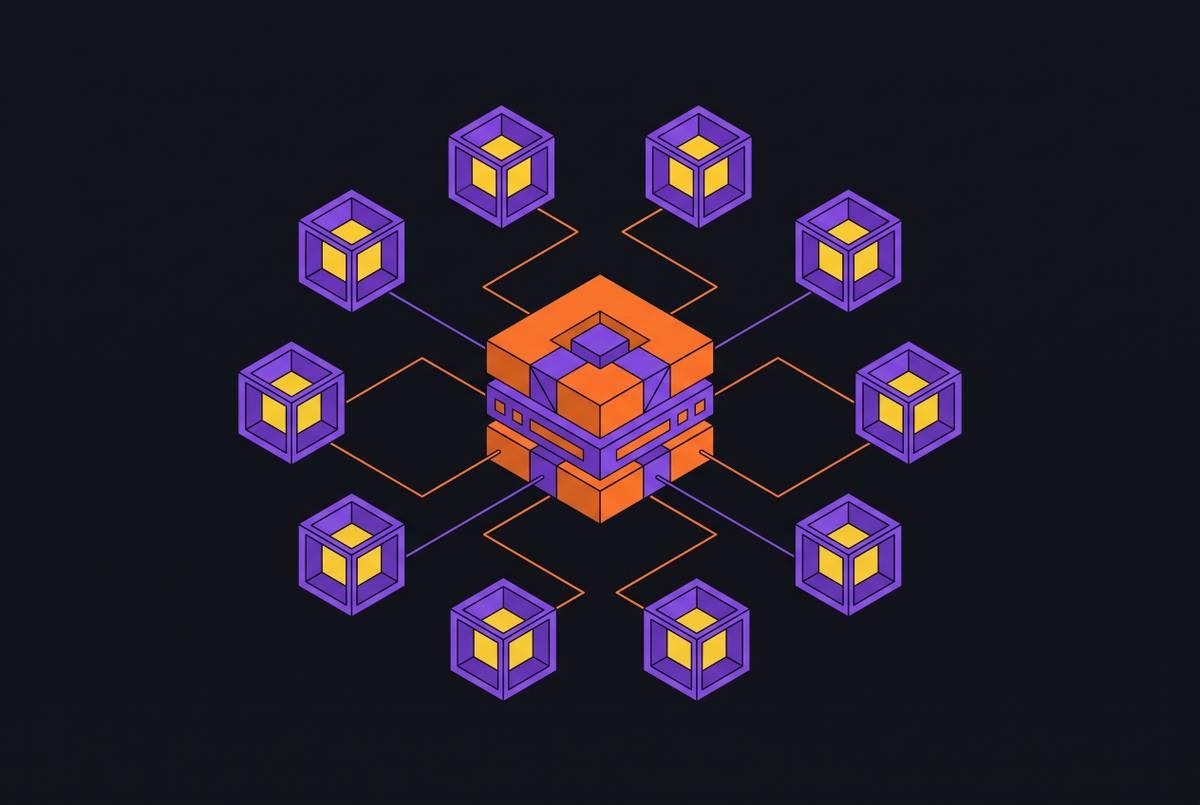
OneDayAgent operationalizes this separation directly. The orchestrator-workers pattern extends this same separation into multi-agent settings: a planner model handles decomposition, a fleet of worker agents handles execution, and subtasks that are genuinely independent of one another can run in parallel while the global plan stays explicit and auditable.
The strongest objection to upfront decomposition is that it is brittle in environments that are genuinely unpredictable. The plan's value was never its predictive accuracy. Its value is as a reference structure against which deviation becomes a detectable event. A plan that turns out wrong in three places is still more useful than no plan at all, because the system learns where it was wrong instead of discovering, hours later, that it no longer resembles its starting intent.
Memory Architecture: The Most Underinvested Layer in Long-Horizon Systems
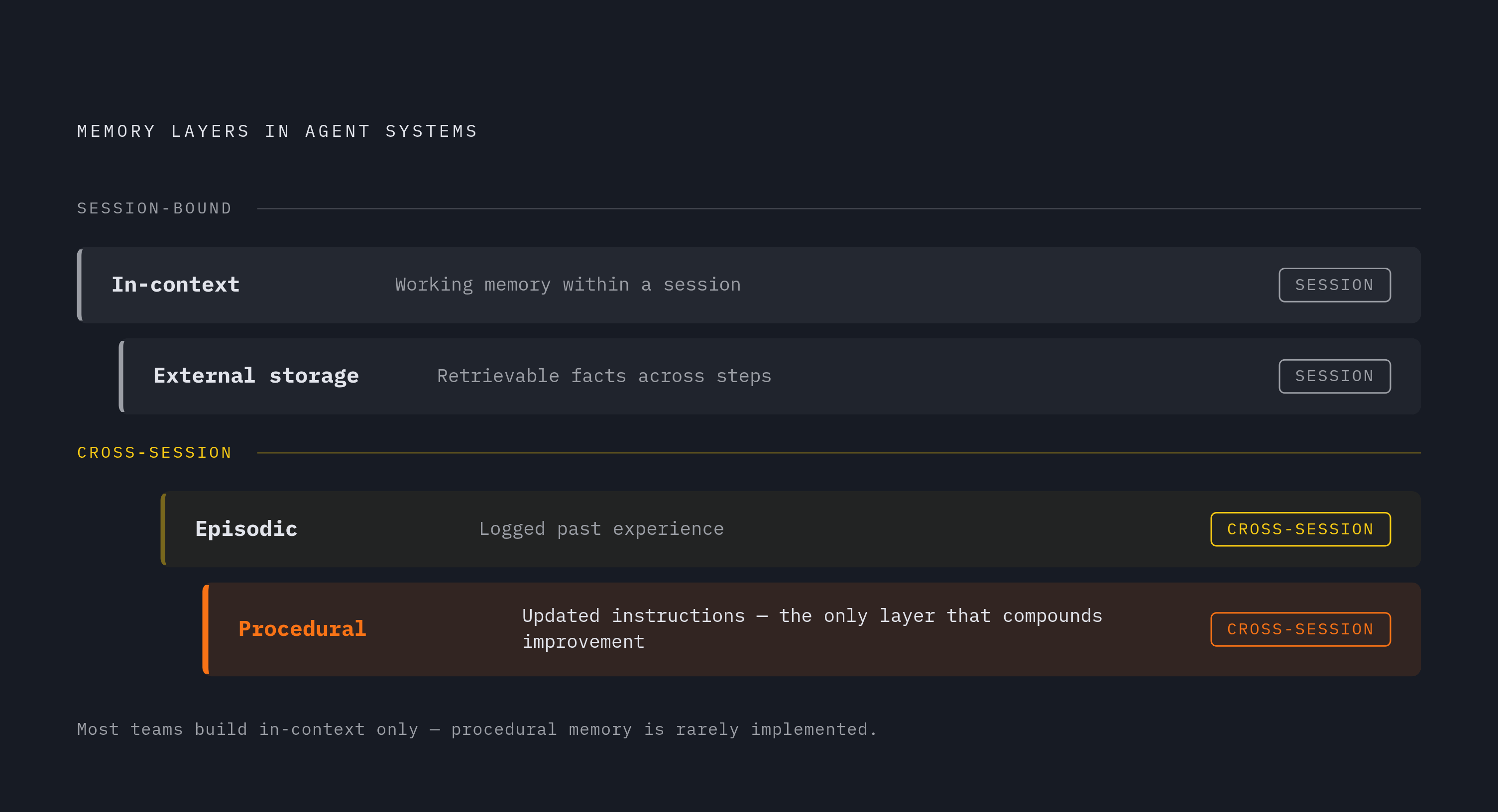
Planning gives a long run a reference point for coherence, but a well-planned run still collapses if the system has nowhere reliable to keep what it has learned along the way. Most engineering teams default without ever choosing a memory architecture. They default to whatever happens to fit in the context window, and that default becomes the binding constraint on the entire system the moment task horizon stretches past a few steps.
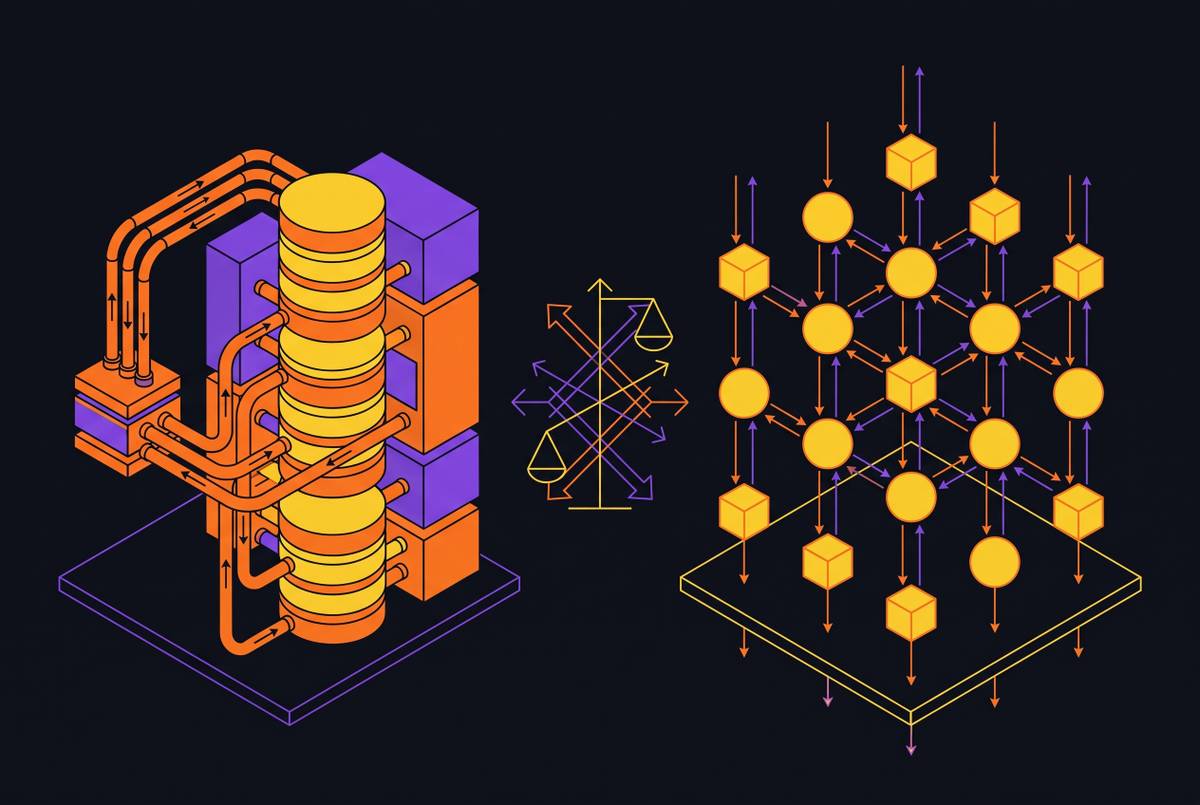
Four distinct memory layers exist, each with its own cost profile and its own appropriate use. Procedural memory stores updated instructions derived from what the agent has learned, and it is the only one of the four that improves an agent across sessions.
OneDayAgent's execution memory module illustrates what a deliberately chosen layer looks like in practice. It compresses observations and checkpoints subtask state under context pressure, relieving accumulation before it overwhelms the context window. It was built to answer one specific question: what happens when context fills up before the task is done.
Teams that skip this design decision are left with exactly one option when context pressure arrives: truncation. Something has to be cut to make room for new input, and whatever gets cut is gone. The formatting requirement dropped by the editing step was not forgotten by the model. It was truncated out of context before the editing step ever ran.
Deciding what to checkpoint is itself a design question with real consequences. Carrying the full conversation history forward instead feels safer but grows unboundedly, and a recovery process built on a full transcript takes longer to resume and costs more every time it does.
Checkpointing as the reliability primitive that turns execution into a recoverable process
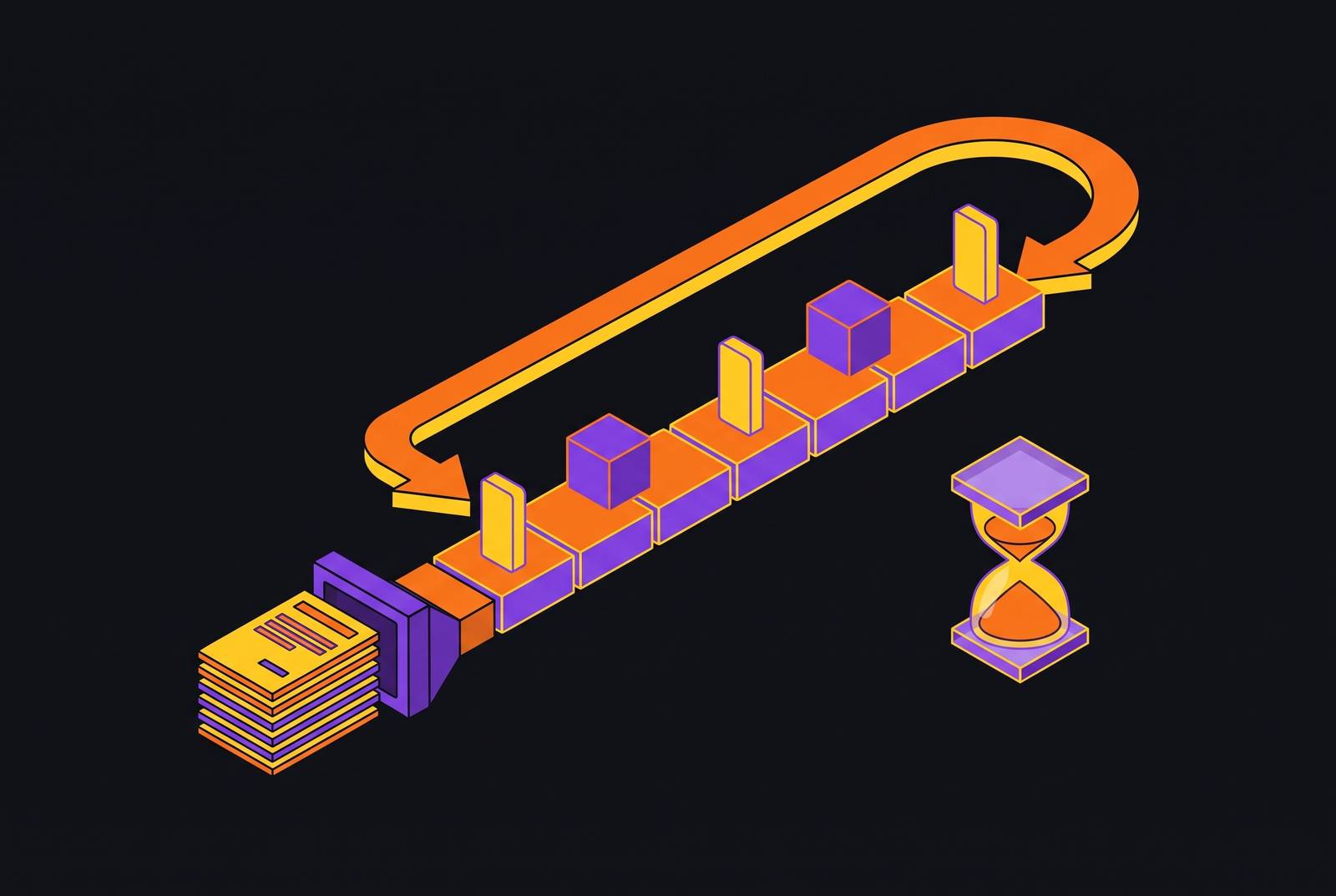
Checkpointing is the structural mechanism that makes a long execution a sequence of recoverable steps instead of a single fragile span that either completes in full or fails in full.
The pattern itself is simple to state.
Granularity is the main design trade-off, and the clear default is to checkpoint after every meaningful unit of work. A document fully processed, a pipeline stage fully completed, each is a natural checkpoint boundary. Checkpoint too infrequently and a single failure erases more progress than it should.
The clearest illustration of how little infrastructure this requires is the "Ralph Loop," a pattern described by Geoffrey Huntley. A list file, a progress file, and a loop are sufficient to make a long run recoverable.
Where that state lives also shapes what checkpointing can do beyond recovery. Local files are sufficient for a single-machine agent working alone. The choice between cheap durable local storage and a shared storage layer that enables that kind of oversight is a product decision about who needs to see what, not a technical constraint.
Decoupling execution from orchestration with message queues
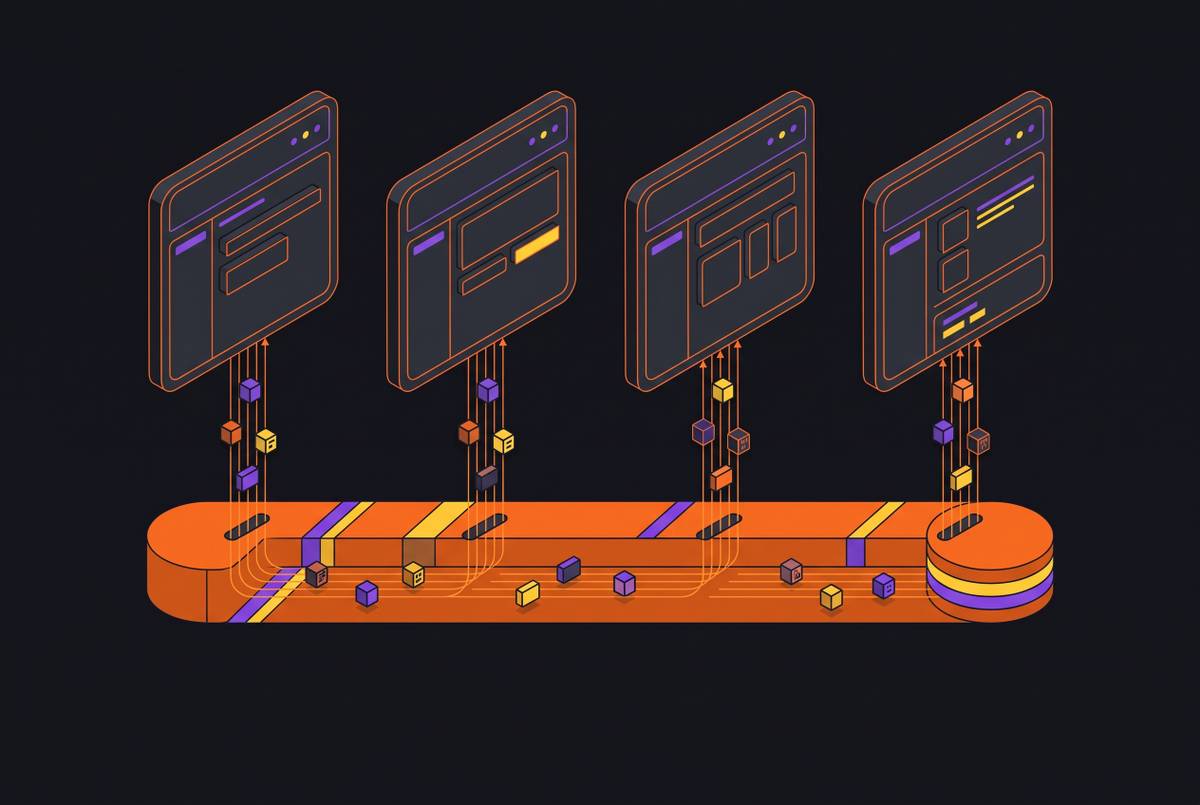
Message queues solve a different problem from checkpointing. Checkpointing protects progress within a single thread of execution. Queues decouple the decision to do a piece of work from the execution of that work, so a failure on either side stops propagating to the other.
In a direct execution model, the orchestrator blocks for as long as the work it dispatched takes to finish. Either side can crash and restart independently without the other side's state being affected.
Queues are not universally warranted. Once that orchestration layer is resilient, the next question is whether the environment each worker executes inside of is resilient in the same way.
VM-Level Isolation: The Right Boundary for Long-Running Agent Workloads
Checkpointing and queuing solve the software-pattern half of long-horizon reliability. Containers and serverless functions were built around stateless workloads that run briefly and disappear. Agents that run for hours, install their own dependencies, accumulate filesystem state, and handle sensitive credentials over the course of a run need an isolation boundary that those primitives were never designed to provide.
A container's security model assumes a workload that is short-lived and stateless. An agent that runs for hours inside that boundary, accumulating credentials and intermediate state as it goes, turns a bounded security risk into a compounding one, because every additional hour of runtime is another hour during which a shared-kernel compromise can be exploited.
Firecracker, the virtualization technology built around a minimal virtual device set retaining only what is necessary to run Linux, takes a different approach. A compromise under this model has to defeat both the workload's own sandbox and the hypervisor beneath it, not merely a boundary wrapped around a kernel the attacker already has access to from the inside.
The performance case for this stronger isolation is concrete. Set against LLM inference times measured in seconds, that overhead is not perceptible. The isolation is close to free relative to the cost of the work the agent is actually doing.
For agents that need to install packages, run a browser, execute arbitrary code, or modify their own environment mid-run, a real kernel with full privileges is the only execution model under which an agent's autonomy does not come at the cost of the host's security.
GPU access is the frontier this logic is now extending toward, as on-device inference during long runs becomes a more common requirement. Firecracker's hardware virtualization path lacks VFIO device passthrough support, since its virtio-MMIO device model has no PCI bus, and a PCI bus is the prerequisite for GPU passthrough. VMMs such as QEMU/KVM or Cloud Hypervisor are required where real GPU access with near-native performance is the goal; gVisor's user-space kernel intercepts GPU calls at a point in the stack that blocks direct PCIe passthrough.
How snapshot-restore turns VM isolation into an economics advantage
Strong isolation sounds like it should be expensive, and for a long time that assumption was correct. The pattern that overturns it is snapshot-restore: when restoring a VM from a snapshot is fast enough, the economically correct move is to destroy the VM entirely during wait periods and recreate it on demand, rather than keep it running and billing for a run that is doing nothing.
The cost this pattern eliminates is what can be called the idle tax, the hidden expense built into any isolation primitive that is slow to create. Multiplied across thousands of mostly-idle agents running at once, this idle tax can dwarf the cost of the actual work those agents perform.
Copy-on-write memory semantics are what make restoring many sandboxes from a single template viable at real scale. Every guest restored from a template reads the same shared template pages at first, and the kernel only allocates a private physical page for a guest the moment that guest actually writes to one. A hundred sandboxes restored from the same template do not cost a hundred times the template's RAM the instant they come up. They cost close to the template's RAM once, plus only the memory each one individually modifies.
This is what makes the oversubscription math work. A large number of stateful agent sessions can be maintained across a small number of physical pods, because at any given moment only a fraction of those sessions are actively executing. The rest sit hibernated, ready to be reactivated the moment they have something to do. The result is a cost structure that finally matches how agents actually run: in bursts, with long waits in between, paying for storage while hibernated and for compute only when actually working, rather than paying standing compute costs for idle time regardless of whether anything is happening.
What verification and repair add to a checkpoint-and-restore harness
A harness that checkpoints every step and restores cleanly from any failure can still deliver a finished artifact that no longer matches what was originally asked for. Surviving every crash along the way says nothing about whether the output at the end still honors the goal and constraints given at the start, and that gap is what verification and repair exist to close.
OneDayAgent's global verification and repair step runs after execution completes, re-aligning the finished deliverable with the original intent of the request. It catches failures that are global in nature, constraints specified early that got lost somewhere in the run, or artifacts that are structurally incomplete even though every individual step along the way appeared to succeed. Once caught, those failures get patched through localized, targeted repair, converting a verification failure into a narrow, scoped update. This is a distinct operation from the per-step checkpointing covered earlier: checkpointing recovers from crashes mid-execution, while verification and repair recovers from a run that completed without crashing but still drifted from its goal.
The evaluator-optimizer pattern generalizes this same idea into a reusable loop: generate an output, critique it against explicit, stated criteria, revise it accordingly, and repeat. An evaluator-optimizer cycle with no limit on its iterations is itself a long-horizon reliability problem, the same kind of unbounded execution this entire piece has argued against, now recurring one layer up, inside the very mechanism meant to guarantee the output is correct.