Serverless Function Constraints That Block Production AI Agent Reliability
Serverless functions lack the persistence and isolation that production AI agents require.
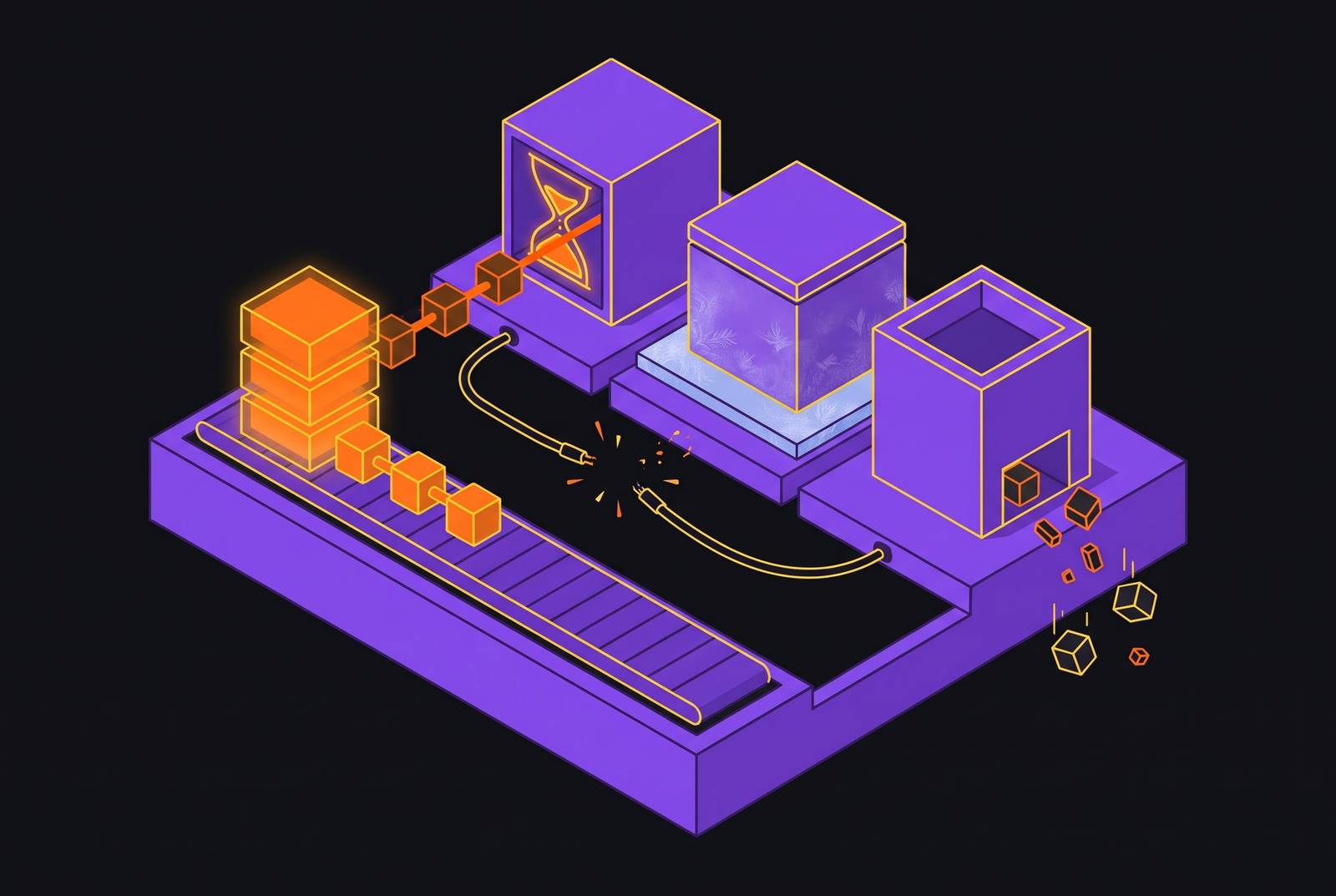
Serverless functions become a reliability liability for production AI agents when disposable invocations cannot preserve the environment, execution time, responsiveness, or isolation the workload requires. Persistent AI agent infrastructure meets these needs together by keeping isolated environments and suspending idle compute, so it need not rebuild context on every wake. The choice depends less on how long an agent’s goal remains open than on what must survive while it is open.
Why serverless functions and AI agents start from incompatible assumptions
Serverless treats an invocation as a disposable unit of work. An event arrives, code runs, and the environment can disappear because durable state lives in a database, queue, or object store. An agent instead takes on a goal and works toward it through many tool calls. Its environment can become part of the work product.
Four terms make the distinction precise. The goal lifecycle describes how long the objective stays open, while the execution lifecycle describes how long one allocation of compute runs. Workflow state tracks how far the agent has come toward the goal, and agent memory keeps context for reasoning later. These concepts are not interchangeable. A three-day goal might use many short executions or need one environment to last the whole time, and each case needs different infrastructure.
How statelessness forces agents to rebuild the context they already built
Statelessness makes serverless environments disposable and cheaply scalable. It also means that an agent cannot count on local memory, filesystem contents, open connections, or loaded dependencies to last between invocations. What a persistent environment retains must instead be externalized or reconstructed. A checked-out repository, installed native dependencies, build artifacts, a warm test runner, a browser session, and a partially written file do not map cleanly to a database row.
Recovery also needs to treat execution state and agent memory as different things. Plan versions, completed actions, artifact versions, approvals, and retry counts describe what the agent has done. Preferences, summaries, and long-term facts help the agent reason later. Memory alone cannot tell which actions have already completed. A durable transaction log tracks what was done, while an external store of conversational context keeps what was said.
Externalizing state to DynamoDB, S3, Step Functions, or a workflow engine is a valid response, but it changes the infrastructure footprint. A function deployment becomes a system with storage, orchestration, queues, retry handling, and coordination logic. Version management becomes part of recovery as well. If an agent suspends for human approval and resumes on different code, its durable journal may no longer match the code being replayed. Execution state thus needs both a durable place to stay and the exact code version that produced it.
What runtime ceilings actually cut off and when they become hard blockers
A maximum invocation duration is a termination boundary. When work exceeds it, the platform ends the invocation regardless of whether the agent is making useful progress. Without checkpointing, there is no designed recovery path. Processing a large codebase, running an extended test suite, waiting for a slow external API, or pausing for human review can all reach that boundary. Even an agent that successfully externalizes its context still faces this execution limit.
AWS Lambda Durable Functions added automatic checkpointing in December 2025 through context.step() and a context.wait() primitive that can pause execution for up to a year without compute billing during the pause. Step Functions Standard Workflows can likewise run for up to a year, with exactly-once execution of states. These mechanisms separate goal duration from compute duration. However, explicit durable steps require an agent designed for checkpoint-and-replay, and retrofitting that structure requires a rewrite.
Restate records LLM responses and tool executions in a journal so that a crashed agent can resume without re-executing prior steps. That recovery depends on its infrastructure and SDK. It is not a property of a generic function invocation. For teams facing a hard runtime limit, the available architectural choices are explicit checkpointing, a workflow orchestrator with its own infrastructure requirements, or moving that workload away from serverless functions.
Cold-start latency and why AI agents pay a structurally larger cold-start tax than ordinary functions
Agent startup includes much more than booting a runtime. A thin Python handler on Lambda can cold-start in hundreds of milliseconds, while an agent importing SDKs can take seconds. Local model inference extends startup into tens of seconds, up to two minutes or more. GPU inference of large models can exceed 110 seconds from download to first token. The agent’s dependencies, rather than the platform boot alone, determine when useful work begins.
Environment reconstruction adds another layer of delay. A PR review agent may need to clone a large repository and install dependencies before it can analyze a single file, which adds minutes before its reasoning moves forward. Scale-to-zero makes this overhead recur after idle periods when the environment must be initialized again. Provisioned concurrency avoids cold starts by retaining warm environments. However, it introduces baseline cost and must be sized for expected concurrency.
Amazon Bedrock AgentCore Runtime charges for CPU only while it is doing work, but charges for memory throughout the session. Free I/O wait is useful for agents waiting on LLM responses, but it does not remove initialization latency. Billing and responsiveness are separate problems to solve. Snapshot-and-restore addresses the latter by capturing memory, CPU registers, virtual device states, and disk files, then restoring through memory-mapped reads. Because that snapshot contains the agent’s working state, its isolation from neighboring workloads becomes part of the same architectural question.
Why shared-kernel isolation is insufficient for agents that execute untrusted code
An agent executing LLM-generated code runs potentially unreviewed instructions produced in response to user input. That code may intentionally or accidentally attempt to escape its environment. Shared-kernel containers provide process and filesystem boundaries, but no separate kernel boundary. A successful kernel exploit can then reach the host and other tenants on it. Prompt injection is especially dangerous when it can shape the code that runs inside this shared boundary.
Host access can expose other customers’ containers, credentials in memory, and data from neighboring workloads. Isolation is therefore a correctness and reliability requirement as well as a security requirement. Preserving an agent’s own state is insufficient if another workload can compromise it. Conversely, durable execution does not compensate for an execution boundary unsuited to untrusted code.
Micro-VMs give each workload its own guest kernel, with a hypervisor boundary separating it from the host and other guests. Firecracker runs in user space and uses Linux’s KVM to create these micro-VMs. AWS Lambda uses this model, so serverless does not inherently mean shared-kernel isolation. A guest-kernel exploit on its own cannot cross the hypervisor boundary. When micro-VM isolation is combined with persistent disk, snapshot restore, and scheduling that suspends idle agents, the same architecture can address state retention, startup delay, and idle cost.
How the four constraints interact to create compound failure modes in production
A human-approval pause shows why fixing one constraint is insufficient. Keeping the invocation alive preserves context temporarily but incurs compute cost and eventually reaches the runtime limit. Ending it avoids that idle execution but requires durable state and coordination before approval arrives. Checkpointing can bridge the wait, yet resumed execution still needs compatible code and suitable isolation. The pause is one event with several architectural consequences.
Repository reconstruction creates a second compound failure mode. Statelessness requires the agent to recover its working environment, and agent-specific initialization turns that recovery into minutes of startup delay. Every wake can repeat work unrelated to the goal. At fleet scale, retaining every environment as running compute substitutes idle expense for reconstruction latency. Snapshot-and-restore scheduling addresses that tradeoff without treating persistence as synonymous with continuous execution.
These interactions also change what operators need to observe. Per-invocation traces describe individual executions, while investigating a long-running goal requires its trajectory across those executions. The debugging unit is therefore larger than the invocation. Correlating several execution contexts becomes necessary when a failure spans a pause, a restart, and reconstructed state. Instrumenting only the function leaves the operator to assemble the goal’s history from separate pieces.
What a production-grade agent infrastructure model looks like when designed against these constraints
For workloads that need to keep an execution environment, an alternative is to use persistent isolated environments with sub-second snapshot wake and pay only for storage during sleep. Each agent has a real filesystem, installed dependencies, credentials, and memory that survive suspension and redeployment. These are working resources. The environment remains available without remaining continuously active. This separates persistence from always-on compute.
Each environment also needs its own kernel when it executes untrusted code or permits agent-driven package installation and modification. The hardware boundary contains that activity independently of neighboring agents. A snapshot then preserves the complete micro-VM state, including memory, CPU registers, virtual device states, and disk. Restoration resumes the retained environment. The micro-VM provides isolation, while persistence and snapshot restore address the state and latency requirements within that boundary.
Sub-second wake is a functional requirement for the interactive model described here. An agent that takes 30 seconds to resume on every interaction imposes infrastructure delay on the product experience. At fleet scale, the cost of idle agents needs just as much attention. AgentCore’s active-CPU billing and Dapr Agents’ actor deactivation take different paths, but both allow agents to sit idle without paying for processing the whole time. The persistent-environment model follows that rule by charging for storage during sleep and compute while the agent runs, with snapshot restore bringing it from sleep back to work.
How to decide when serverless is the wrong choice for an agent workload
The practical diagnostic begins with what must survive between steps. Does the agent need filesystem state, installed dependencies, or intermediate artifacts after an invocation ends? If so, a function-based design needs external storage and reconstruction, and the coordination overhead belongs in the evaluation. Conversation history is not an adequate proxy. The relevant inventory includes both execution progress and the environment needed to continue it.
Does any reasoning step, tool call, or wait for an external event exceed the platform’s maximum invocation duration? If it does, explicit checkpointing must be part of the design before execution. Goal duration alone gives the wrong answer. A three-day goal that has no environment dependencies may fit durable orchestration, while a two-minute goal that uses a checked-out repository and native dependencies may need a persistent environment.
Responsiveness requires measuring the complete initialization path, including SDK loading, dependency installation, and repository cloning. Does that full startup cost exceed the use case’s acceptable response latency? If so, scale-to-zero with reconstruction conflicts with the product requirement. Isolation requires a separate assessment. If the agent executes LLM-generated code, runs untrusted scripts, or shares infrastructure with other tenants, shared-kernel containers do not provide the required production boundary for that threat model.
Event routing and webhook handling may belong on functions, while multi-step reasoning that needs to keep environment state belongs on persistent isolated compute. Durable orchestration can bridge long goals composed of resumable steps. Serverless is a reliability liability when the workload requires guarantees that the chosen execution model does not provide, and the design has no deliberate mechanism to supply them.