Multi-Agent Orchestration With Shared State
Shared state coordination prevents agents from conflicting, not model intelligence.
Two booking agents reserve the same conference room because neither one knew the other was looking. A file gets overwritten mid-edit by a third agent that had no idea a second one was still reading it. These are not bugs born of weak models. They happen because shared state got treated as an afterthought instead of the thing the whole system depends on, and that single design choice is why most multi-agent deployments fail once they leave the demo environment.
Why multi-agent orchestration keeps failing in production
Picture an agent sent to confirm a hotel room while a second agent, working the same itinerary, reserves a different room ten seconds later, and a third agent cancels both because its view of the booking was already stale by the time it acted. None of these agents did anything wrong on its own. The trouble starts the moment more than one of them touches the same piece of state without a rule for who gets to touch it when.
Single-agent systems run into a ceiling that's well understood by now: pile enough competing instructions into one context window and reasoning quality drops, and when something goes wrong it's hard to tell which instruction caused it. The instant a system has more than one agent, it inherits decades of distributed-systems hazards: race conditions, lost updates, deadlock, duplicate actions. The added twist is that each "process" in this system is a probabilistic model, one that can improvise its way into trouble a traditional program never would.
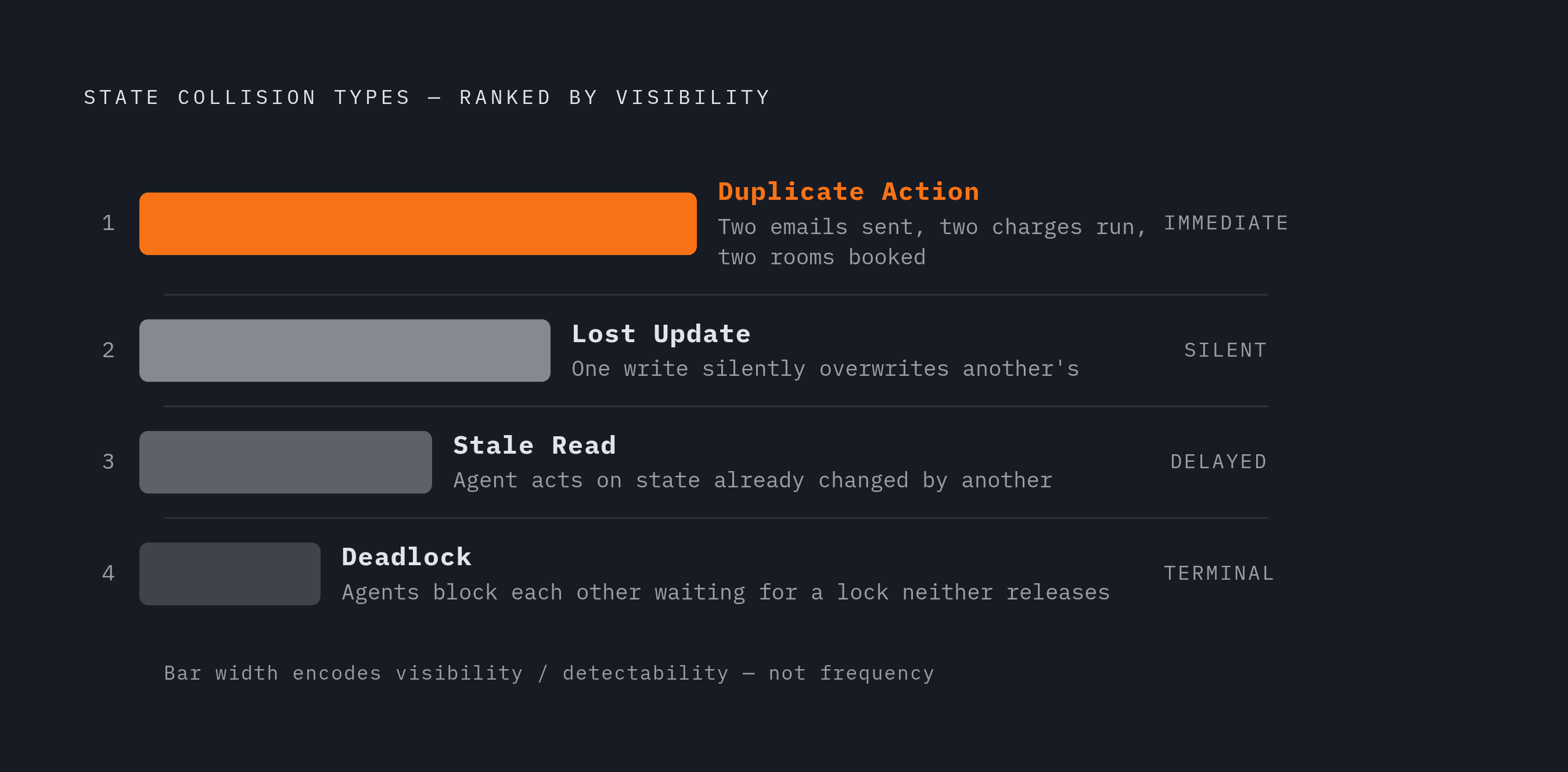
Four collision types occur consistently in systems where agents share state without coordination rules. A duplicate action happens when both agents fire the same side effect because neither one knew the other had already acted, sending two emails, running two charges, booking two rooms.
None of these four are exotic artificial-intelligence problems. The hard problem in agentic AI stopped being about making a single agent smarter a while back. It's about making a team of agents work together without stepping on one another, and that's a problem solved with architecture, not with a cleverer prompt.
Shared State and What It Must Survive
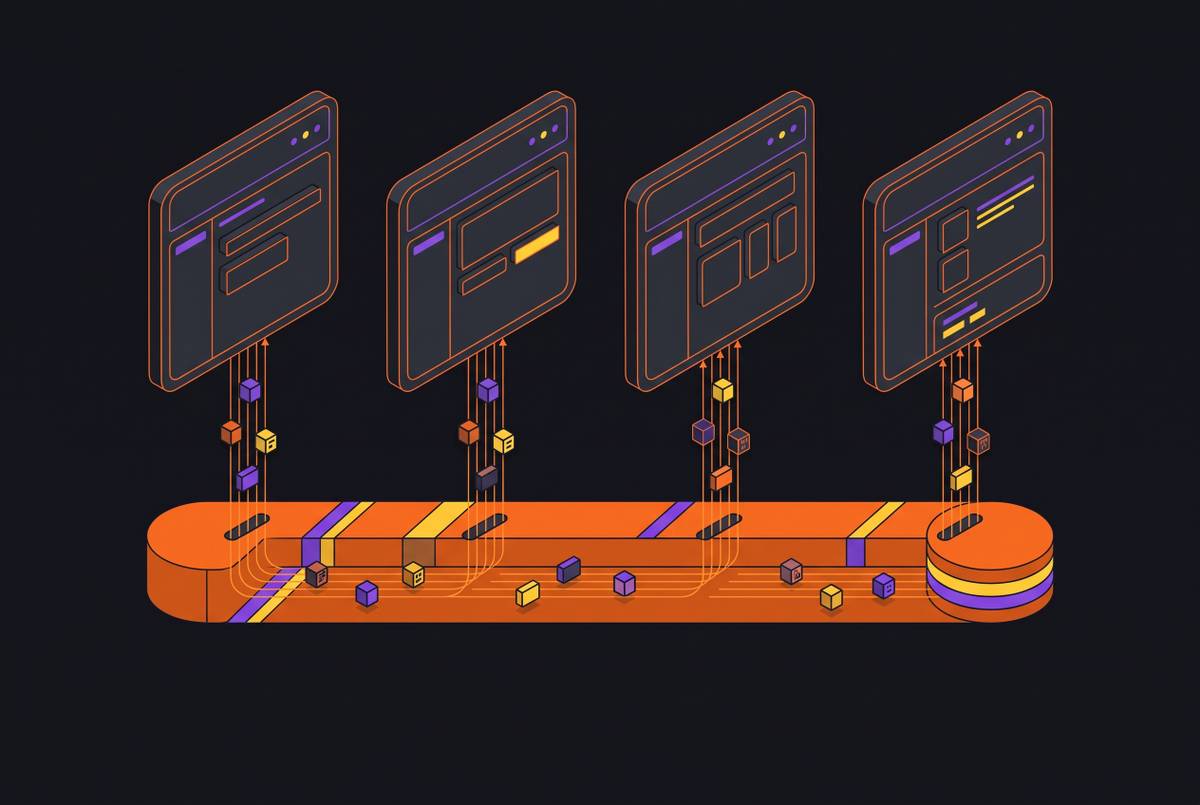
Shared state is the persistent coordination layer that every agent in a system reads from and writes to. Shared state is the contract that makes parallel execution coherent at all, the record that tells every agent what has already been decided and by whom.
This is where most builds quietly fail. Production is a different animal. For shared state to hold up once real traffic hits it, it has to survive concurrent writes from agents acting in parallel, agent restarts in the middle of a task without losing the context that task had already accumulated, changes in topology such as adding or removing agents without corrupting the record those agents share, and real-world side effects that can't be undone if the state record turns out to be wrong.
The blackboard pattern, where agents read and write a common workspace with no central coordinator, is the clearest expression of why this matters. It offers maximum flexibility and also the highest collision risk, because nothing stops two agents from writing to the same square of the blackboard at once unless the state layer itself enforces rules. The architectural error that causes most production failures is treating an agent's own memory, which is transient and tied to that agent's process, as if it were the same thing as the shared context layer, which is the persistent store that has to outlive any single agent's lifecycle.
How the four orchestration topologies each stress shared state differently
Picking a topology is, whether a team realizes it or not, a decision about how the shared state layer will be stressed. Each of the four common patterns pushes on state in a different place, and choosing one without understanding its particular failure mode means building a state layer for the wrong threat.
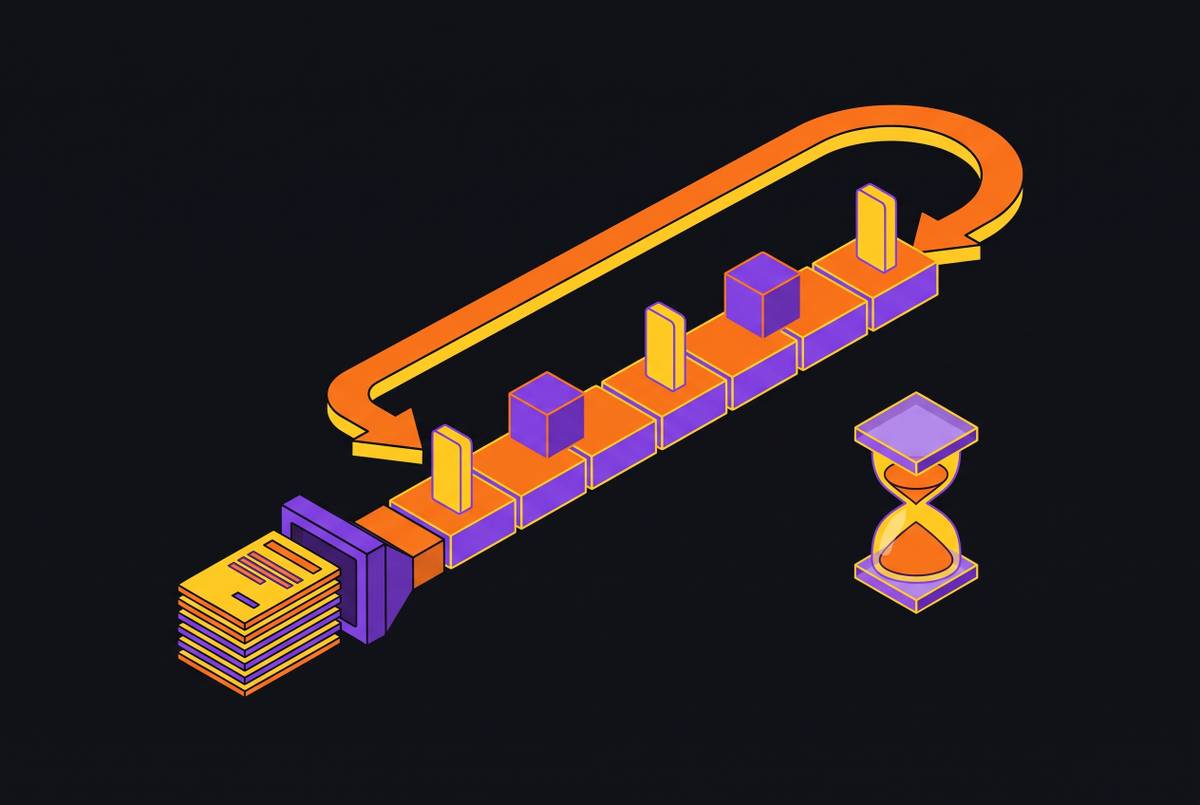
A sequential pipeline passes state linearly from one agent to the next. Coordination overhead stays low because each agent only has to hand off to the one after it, but error propagation becomes total: bad output at stage one flows into every downstream agent with no way to backtrack once it's gone. A four-agent pipeline can accumulate around 950 milliseconds of coordination overhead against roughly 500 milliseconds of actual processing time, so the system spends more time passing work along than doing it.
The orchestrator-worker pattern is the most common one found in production. The orchestrator also becomes a single point of failure for every write to shared state, since nothing gets coordinated if that one node goes down.
What runs through all four patterns is the same requirement. Agents need to coordinate through explicit, observable channels, messages, leases, a single source of truth, never through invisible edits to a shared variable that no one else can see happening. The moment two agents can silently mutate the same piece of state, a bug is waiting for a busy enough day to show itself.
Six coordination mechanisms that prevent agents from overwriting each other
Preventing state collisions isn't new territory. Distributed systems solved most of this years ago, and the mechanisms carry over to multi-agent architectures with little modification.
A single source of truth enforced through time-boxed leases means one agent writes at a time while others wait their turn. This directly prevents race conditions and lost updates, and because the lease expires on a timer, an agent that dies mid-write doesn't leave the system deadlocked waiting for a lock that will never release.
None of these six need to run at once. The discipline is to use the simplest topology that fits the task and add controls only as coupling between agents and their autonomy increase. More orchestration machinery is not automatically better orchestration.
How Frameworks Implement Shared State
Choosing a framework is, in practice, choosing a state-management philosophy, and each framework's gaps follow from that philosophy.
LangGraph models workflows as directed graphs carrying typed state, with a shared state object that moves through the graph as it executes. Built-in checkpointing persists state at every transition, which enables time-travel debugging, human-in-the-loop approval steps, and recovery if execution fails partway through. Recent additions include node caching, deferred nodes that act as native fan-in barriers for coordinating fan-out and fan-in work, and pre- and post-model hooks for trimming context and applying guardrails, features that arrived through LangGraph's release cycle (deferred nodes date back to May 2025). Of the major frameworks, LangGraph's state management story is the most complete.
Microsoft's Agent Framework 1.0, the successor to AutoGen and Semantic Kernel that shipped in April 2026, takes a different approach. A2A governs how agents delegate tasks and communicate with one another; MCP governs how agents access tools. State coordination here is protocol-native rather than graph-native, a different philosophy than LangGraph's but one aimed at the same problem.
CrewAI leans on a role-based metaphor and handles task delegation and output passing between agents directly. Its developer experience is the strongest of the three: a working multi-agent system can be built in very few lines of Python. Teams have to add their own coordination primitives on top.
What all three share is a boundary. Each handles state well inside its own framework and leaves cross-framework and cross-restart state to the developer building on top of it. Neither protocol solves durable persistence across agent restarts; that problem lives below the framework layer.
Durable Infrastructure Below the Framework Layer
No framework, no matter how complete its checkpointing story, can guarantee state survives an agent restart without durable execution infrastructure sitting underneath it.
Agent memory is transient at the process level. When an agent's process dies or gets evicted, anything in memory that wasn't explicitly written somewhere durable is gone. Frameworks can checkpoint state to disk, but a checkpoint written to a disk that disappears when its host gets replaced doesn't survive anything.
Durable execution is the software answer to this. When an agent needs to wait, on a tool's response, on human approval, on a timer, the execution harness snapshots the full state: memory, call stack, pending continuations, all of it, to durable storage. The process then terminates and compute drops to zero while nothing is happening. When the moment to resume arrives, that state is restored exactly as it was.
This snapshot-and-restore model carries a specific concurrency requirement. A file sitting on the local disk of one VM is not shared state, no matter how reliably that one VM behaves.
VM-level isolation gives multi-tenant systems the right boundary for agent state. Each agent running in its own isolated micro-VM gets a persistent disk, a real kernel, and the ability to sleep and wake without losing its place. State persists across sessions because the storage layer underneath is durable by default, not because a framework happened to save it in time. The isolation also means a state corruption or crash inside one agent's VM can't bleed into the shared state owned by another agent.
Raw Firecracker, though, only supplies the isolation primitive. It doesn't handle image distribution, networking, warm pools, autoscaling, or observability, and a team building a production multi-agent fleet directly on raw Firecracker owns all of that work itself.
The economics of running shared state at scale across a multi-agent fleet
Running shared state at fleet scale is an economics problem as much as an architecture one, and the dominant cost driver is idle time.
An agent's bill is shaped far more by how long it sits around waiting than by how long it spends actually computing. A VM that handles a short burst of real work and then stays warm for a much longer stretch afterward has spent most of its billed time doing nothing useful.
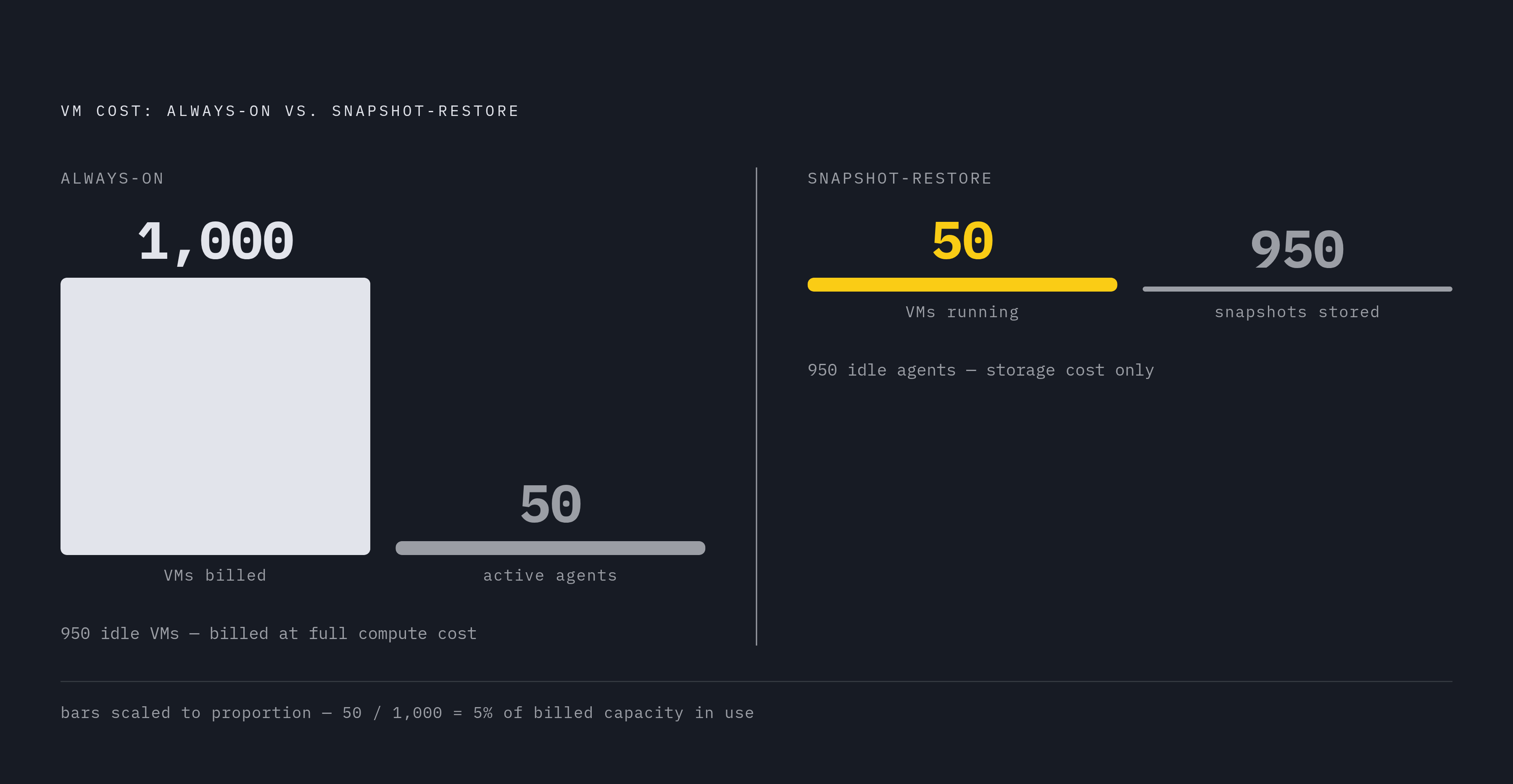
The snapshot-restore model turns that idle compute cost into idle storage cost instead. A dormant agent, suspended as a snapshot rather than kept running, pays for storage space at a fraction of what a warm, idling VM costs to keep alive.
This matters most at fleet scale, because fleet size is really set by how many sessions are idle at once, not by how much active work is happening. A system with a thousand users, each holding a warm agent session, where only fifty of those agents are doing anything at a given instant, pays for a thousand VMs under an always-on deployment model while using the capacity of fifty.
A two-tier lifecycle is the practical answer. Agents used recently stay in an active tier, resident in memory and ready to respond fast. Agents idle past some threshold move to a dormant tier: snapshotted to disk, their VM terminated, restored lazily through memory mapping the next time a prompt arrives, with full RAM reclaimed on wake. Model inference still accounts for the large majority of total cost in most deployments, though infrastructure, orchestration, tooling, and governance can dominate the bill in tool-heavy or compliance-driven workloads. That means the scheduling model governing idle and active agents has more leverage over total fleet cost than the choice of model does.
Designing a Shared State Layer for Concurrent Writes, Restarts, and Scale
Everything above points to the same conclusion: a shared state layer that survives production has to be designed across four distinct concerns, storage, concurrency control, durability, and observability, each with its own specific requirement.
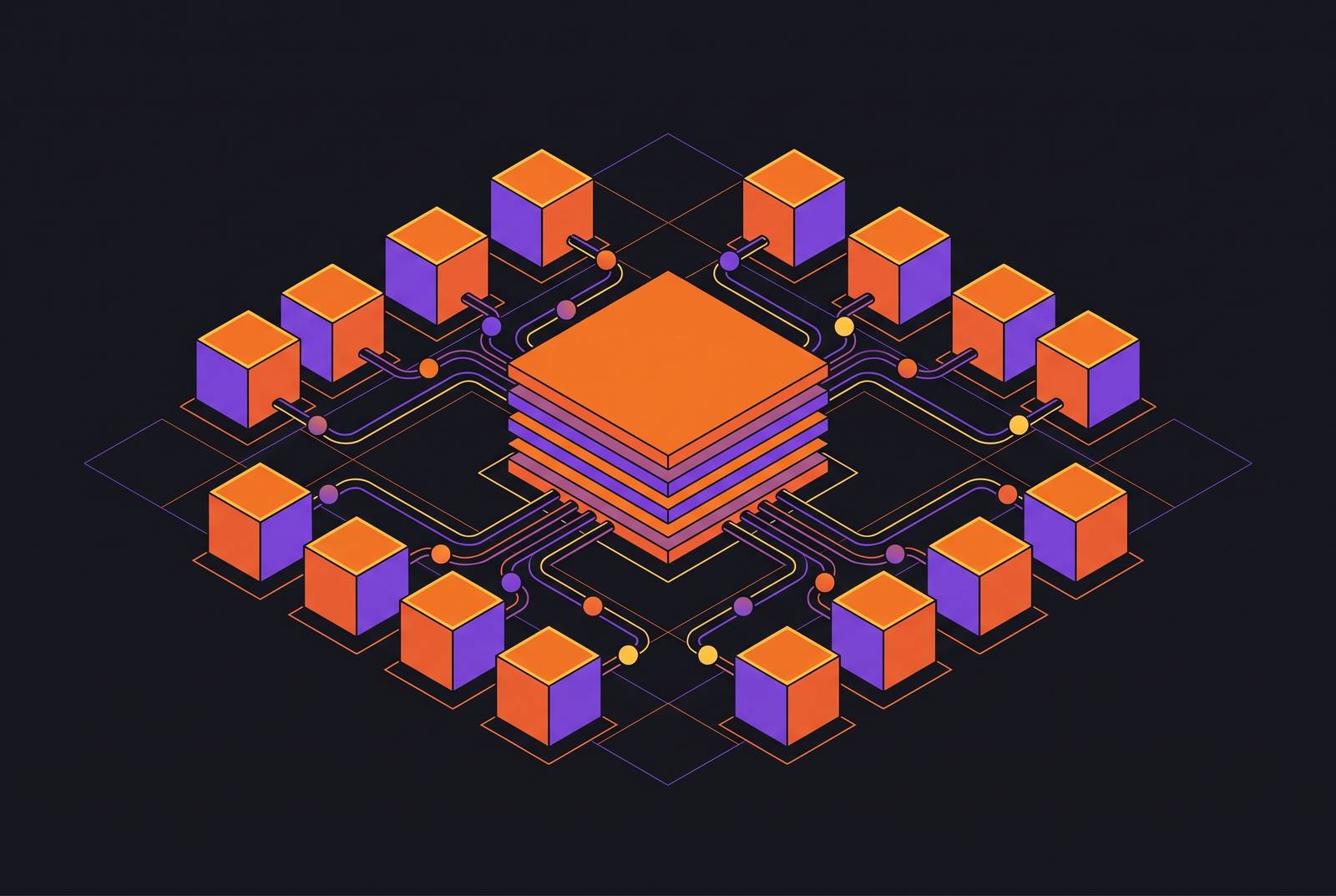
Storage has to live outside any individual agent's VM. State needs a store that every agent in the fleet can read and write, one that persists independently of whether any single VM is running. Per-agent persistent disks, the kind micro-VM architectures provide, are the right place for agent-local state, but the shared coordination layer sits above that, as a separate store.
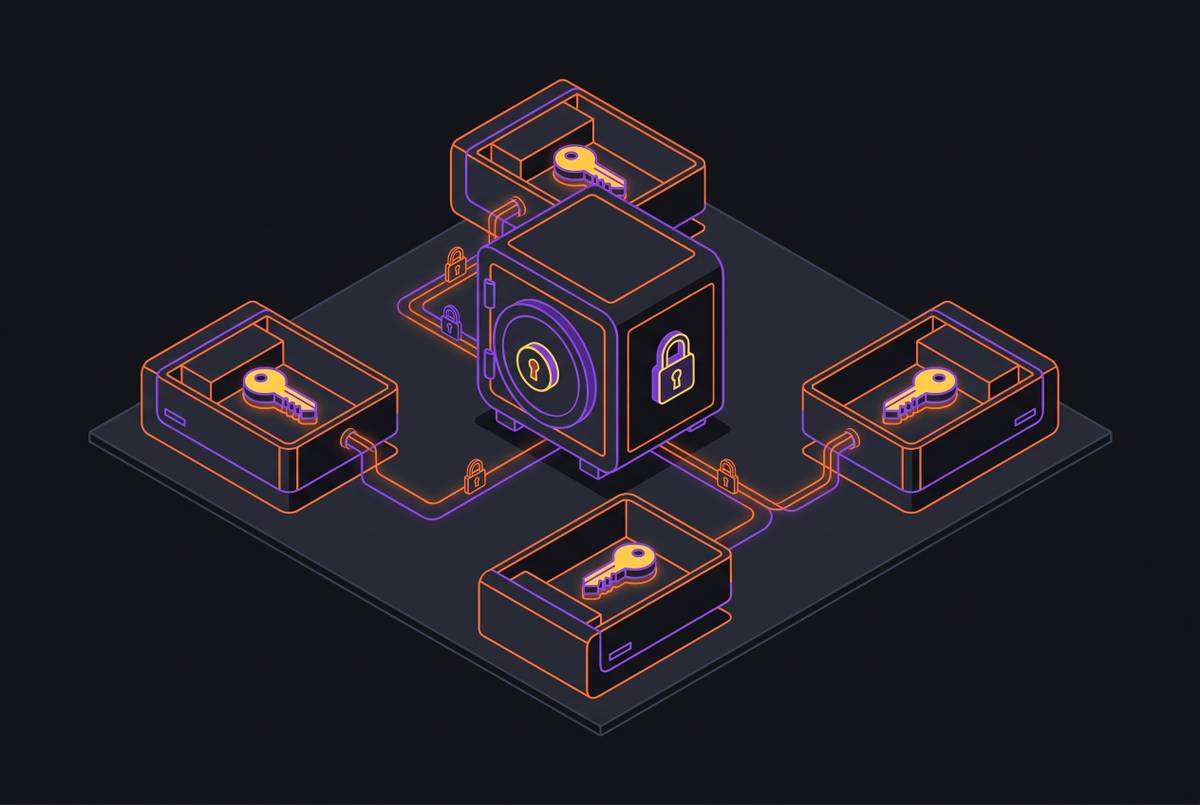
Concurrency control runs on lease-based write ownership. Time-boxed leases keep writes from silently overwriting one another, and because the lease expires on its own, an agent that dies mid-write doesn't leave the system locked forever. Idempotent tool calls built on deduplication keys stop retries from producing duplicate real-world actions when a state inconsistency triggers one. Role boundaries need to be enforced at the state layer itself, not just suggested in a prompt. An agent that shouldn't write a given field shouldn't be able to write it, full stop.
Durability comes from checkpointing tied to real lifecycle events: task completion, handoff between agents, a pause for human approval, and any point just before an irreversible real-world action. VM-level snapshot-restore complements that framework checkpointing by preserving an agent's full execution context, memory, call stack, and pending continuations, even if the VM itself gets terminated between tasks.
Observability means every mutation to shared state produces a traceable event. In peer-to-peer topologies especially, state changes are scattered across pairs of agents, and without a shared context layer capturing each interaction, reconstructing what actually happened after something goes wrong isn't realistic. The A2A protocol's signed Agent Cards, which use cryptographic signatures for domain verification as part of its March 2026 v1.0 stable specification, give multi-tenant fleets an identity layer that makes this kind of state attribution trustworthy across agents built by different teams or on different frameworks.
The sequence for building this matters as much as the pieces themselves. Establishing role boundaries and a single source of truth comes first. As the number of agents grows, add lease-based concurrency control. Add VM-level snapshot-restore once session continuity across restarts becomes a real requirement. Add full observability instrumentation before expanding how much autonomy any agent is given. That order is the argument this piece has been making from the start: shared state isn't a detail to bolt on once the agents are smart enough, but the foundation everything else gets built on.