Vendors Offering Snapshot-Restore Scheduling for AI Agents
Snapshot-restore scheduling cuts idle compute costs while preserving agent state between tasks.
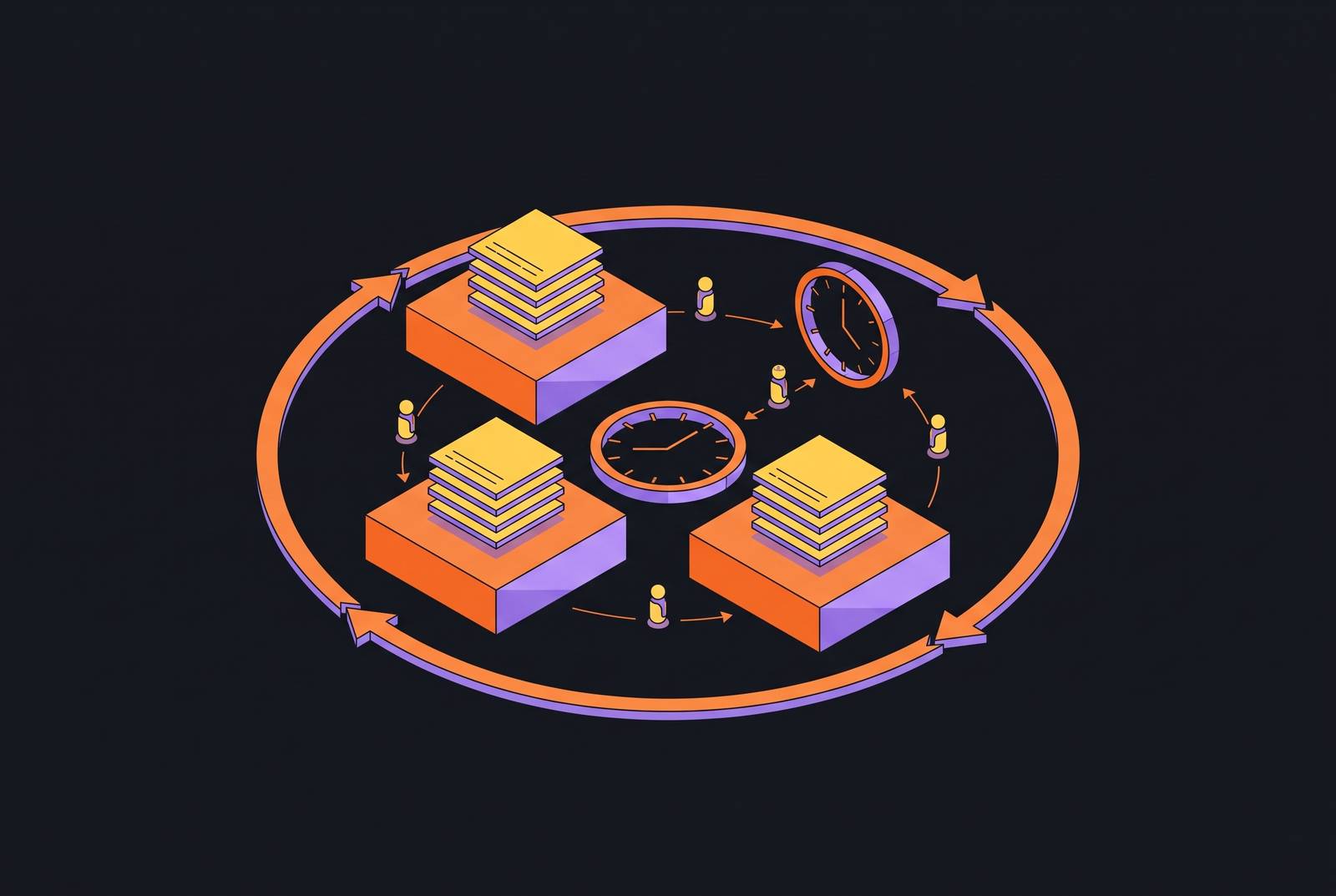
Snapshot-restore scheduling frees compute when AI agents are idle and keeps the runtime state they need to resume without rebuilding the environment. It reduces costs only when suspended agents stop accruing compute charges and their snapshots survive the gaps between tasks. Vendors offering this pattern differ on three decisive criteria, which are capture depth, restore latency, and snapshot longevity.
Why pay for compute when persistent AI agents are sitting idle?
A persistent agent accumulates more than conversation history. A coding agent may clone a repository, install a toolchain, and run analysis before it can do useful work. Destroying its environment at the end of a session means repeating that preparation from a blank base image. Each time the agent returns, it may spend minutes on the same setup.
Keeping the environment warm saves that rebuild. Idle containers still consume host memory and CPU even when the agent has nothing to do. Across thousands of per-user sessions, those allocations make always-warm environments economically unsustainable.
How fast that cost grows depends on the billing model. Most providers charge for wall-clock CPU and memory, but a smaller set bills for actual CPU use, so idle periods cost almost nothing. The right scheduling approach must therefore preserve accumulated state and release the compute allocation during inactivity.
What snapshot-restore scheduling actually captures and how the mechanism works
A full snapshot-restore cycle serializes runtime state at hibernation, releases compute, and later maps the saved state into a fresh virtual machine. Processes resume at the instruction where they stopped. To pick up where it left off, an agent needs its writable filesystem, guest memory, and machine state saved along with its files. The unchanged, read-only base image can remain on the host.
Firecracker’s official snapshot documentation distinguishes guest memory from emulated hardware state and says disk files are managed separately by users. That distinction is important for platform claims. A VM snapshot operation does not, by itself, establish that the writable disk has been preserved. The platform must keep track of both runtime state and disk state.
Dirty-page tracking cuts the work of taking repeated checkpoints because it writes only the memory pages that have changed since the previous checkpoint. Sabre at OSDI 2024 compressed diff snapshots two and a half times on average. Some state still needs repair after restoration. AWS Lambda SnapStart’s best practices flag that network connections do not survive restore, so agents need post-resume reconnection hooks. Cached UUIDs, session tokens, random-number-generator state, and credentials also resume unchanged, requiring clock checks and credential refresh.
Why Firecracker micro-VMs became the standard primitive for this pattern
Firecracker has fast boot, low memory overhead, and VM-level isolation, which make it a good base for sub-second restoration. Fast startup supports responsive resumption, while low overhead supports large fleets. VM-level isolation puts a stronger boundary between tenants than container namespaces that share a kernel.
Snapshot-based copy-on-write forks also suit agent exploration. A platform can branch warm memory and disk to try multiple execution paths from the same starting point, such as five fix attempts with the successful branch retained. The value extends beyond waking an idle agent. The same preserved environment becomes a starting point for parallel work without repeating its preparation.
Containers are enough for low-risk workloads, but compliance-sensitive multi-tenant deployments need stronger isolation than shared-kernel namespace isolation provides. Kubernetes 1.37 introduced pod-level checkpoint and restore as an alpha feature, delegating implementation to the container runtime. Edera’s Project Lunchbox takes a different approach on Kubernetes, wrapping each agent in an isolated micro-VM with a private Linux kernel. Its freeze-fork-resume model is built for production fleets that have thousands of sessions running at once.
The three dimensions that separate implementations — capture depth, restore latency, and snapshot longevity
Capture depth sets how much of the agent is saved. Without in-memory process state, the agent restarts its execution logic. Without the writable filesystem, it may need to reinstall packages. A file checkpoint and a full runtime checkpoint therefore satisfy different requirements, even when both are described as snapshots.
Restore latency is how long a user waits when they return. But a latency figure can guide a choice only when it comes with the conditions it was measured under, including whether restoration uses a warm cache or cold storage. A fast restore on its own does not show how fast concurrent restore requests will be under fleet load.
Snapshot longevity sets whether a snapshot will still be there to restore when the agent returns. AWS Lambda SnapStart deletes Java snapshots after a period of inactivity, illustrating why expiration belongs in the comparison. For a platform preserving accumulated agent work, expiration can force repository, toolchain, or test-environment rebuilds. A slower restore from a durable snapshot can therefore serve an intermittent workflow better than a faster restore available only within a short retention window.
How named platforms handle the three axes in practice
Cloudflare Sandboxes reached general availability in April 2026 and runs on the Workers Paid plan for a low monthly fee. Capture completeness, restore guarantees, and expiration policy require a separate three-axis comparison.
Celesto AI published SmolVM on April 21, 2026, as an Apache 2.0 open-source project addressing the threat-model mismatch of Docker containers and Python subprocess calls for LLM-generated code execution. With its snapshot-and-fork pattern, the effective cost of creating a VM drops to near zero when the same operations run again. Edera’s announcement, by contrast, emphasizes isolated agent fleets on Kubernetes and freeze-fork-resume without runaway memory costs. Neither description alone establishes a snapshot retention guarantee.
TroveFiles’ agent snapshot documentation describes workspace recovery. One API call captures a namespace, and another restores it by wiping the current namespace and re-extracting the snapshot. Recovery covers the whole namespace and is atomic per file. It is not a selective revert or per-file diff, and it should not be mistaken for restoring guest memory.
The same documentation describes namespace-scoped isolation, signed snapshot-created and snapshot-restored webhook events, and tools callable from agent code. These support checkpoints before destructive operations and known-good rollback targets after successful tasks. This is a distinct recovery primitive. Its usefulness depends on whether the workload needs workspace rollback, runtime continuity, or both.
When snapshot-restore state diverges from the real world
A snapshot preserves the past. An agent waking weeks later may find that credentials have expired, tokens have rotated, or external filesystems have unmounted. The agent cannot learn of those changes from its saved memory alone. Successful restoration proves that state was recovered.
File-only snapshots have the same temporal limitation. A restored workspace reflects the moment of capture, and an agent may treat stale records with the same confidence as fresh ones. Capturing more internal state can preserve more assumptions that need to be checked.
The practical response is explicit post-resume verification. Agents need hooks that re-fetch time-sensitive state, reconnect external services, check the guest clock, and refresh credentials before they use saved context. Longer retention increases the need for such checks because more external change may have occurred.
How to tier snapshot depth and approval gates by the risk of the agent action
The design response is to match snapshot depth and execution gates to the permanence of the side effect. Low-risk actions, including summarizing documents and searching logs, call for preserving the prompt, sources, and output trace. Medium-risk actions, such as editing a draft or creating a test branch, call for object versions, a file diff, and a tool journal. These records serve different recovery needs.
High-risk actions require more than a lightweight checkpoint. Running a migration or changing permissions calls for a full data snapshot, approval, a dry run, and a restore test. Critical actions, including deleting records, charging money, and sending external messages, require delayed execution, human approval, and a compensating workflow. At that tier, a snapshot alone is insufficient.
Retention follows the same risk gradient. Compliance-sensitive, high-risk snapshots are retained up to the platform maximum, with a fresh snapshot taken before the window closes when longer coverage is needed. Critical-action approvals warrant longer retention still, paired with aggressive redaction of sensitive payload data.
Agents can participate directly in this workflow. TroveFiles exposes create_snapshot() and restore_snapshot() as callable tools, allowing an agent to checkpoint before a risky step and undo workspace changes if the step fails. That capability belongs within the risk controls, with approval still required. Snapshot strategy is a workflow layer between the risk classifier and the execution engine.
The strongest objection — snapshot complexity undermines the simplicity argument
Snapshot-restore can weaken the operational simplicity argument for micro-VMs. Short, latency-sensitive workloads often require a hot pool, diff snapshot logic, and aggressive reuse scheduling on top of Firecracker. Those components introduce complexity that the underlying VM primitive does not remove. A team choosing micro-VMs for simplicity can end up owning a substantial scheduling system.
The objection is valid, but workload fit determines its force. gVisor on Kubernetes fits existing infrastructure and handles many agent workloads. Moving to Firecracker makes sense when missing syscalls block a specific workload or when too many short-lived containers on a shared host produce unfavorable economics. The transition needs a concrete reason.
With managed platforms, builders can get scheduling and restore logic without running those components themselves, though they still need to check how they behave. The second objection, that freshness and durability outweigh millisecond differences, is also valid. Restore speed cannot compensate for a snapshot that has expired, and durable state cannot compensate for missing post-resume verification.
What to look for when evaluating snapshot-restore infrastructure for a specific agent pattern
For infrastructure selection, the first question is whether snapshots persist indefinitely or expire on a fixed schedule. Long-running interactive agents may wait for human input with no work that needs compute. A retention window shorter than those pauses forces rebuilds precisely when continuity is needed. Expiration policy should be evaluated against the agent’s actual return pattern.
Confirm whether the platform preserves guest memory and process execution state as well as the writable filesystem. Then distinguish warm-cache latency from cold-storage latency and ask what happens under concurrent restoration. A platform that restores files is recovering a workspace.
Billing requires its own explicit check. Ask whether suspension stops both CPU and memory charges or merely stops execution while memory remains billable. A billing model that fits hibernation charges for storage while the agent is suspended and for compute while it works. A pause API alone does not establish that economic behavior.
Workload shape adds two further requirements. Best-of-N execution and parallel exploration need copy-on-write forks from a warm starting state, while per-user fleets need isolation that prevents one session from accessing another user’s snapshot. VM-level boundaries and namespace-scoped workspace isolation address different layers of that requirement. Neither should be treated as a substitute for understanding what the platform preserves.
For per-user agent products, the target architecture is specific. Each user’s agent retains its disk, memory, and process continuity while spending most of its time in a hibernated snapshot, paying only for storage during hibernation. When the user returns, it wakes in under a second and verifies the state that may have changed outside it.